Tuesday, August 6, 2013

4 Wild Animals You Can Protect On Your Next Vacation

It seems that every day another news article comes out about animals facing extinction. The list of reasons is seemingly endless including loss of habitat, the wildlife trade, and climate change. What the media rarely covers is the stories of hope, where communities come together to protect the animals that live around them.

There are many of these stories around the world, where dedicated conservationists are coming up with innovative ways to help these endangered species recover while improving the lives of local residents. Many of these programs include volunteer activities for travelers to participate in research and conservation programs. 

Here are just a few of the opportunities for travelers to help wildlife:
(credit Elizabeth Moreno)
  • Green Sea Turtles in Baja: Years ago, many turtle researchers wrote off Baja’s turtles as beyond saving.  However, an award-winning network of fishermen, scientists, and local residents called the Grupo Tortuguero formed to study and protect the region’s five species of sea turtles and numbers are rebounding. A new locally run business called RED Sustainable Tourism is helping these conservationists recruit volunteer help for their turtle research. Participants camp on a small island in Magdalena Bay and help to set nets to catch green turtles at sea and collect information on them before returning them to the water.
(credit Wild China)
  • Giant Pandas in China: Pandas live in isolated patches of mountain forest in central China. Their numbers in the wild have dwindled to less than 2,500 due to conversion of forest to farmland and other uses. The World Wildlife Fund’s China program is working to expand protected areas and encourage local residents to protect their forests. Travelers with Wild China can track pandas in the Wanglang Nature Reserve, visit a panda breeding center, and support WWF’s efforts to train local residents as tour guides.
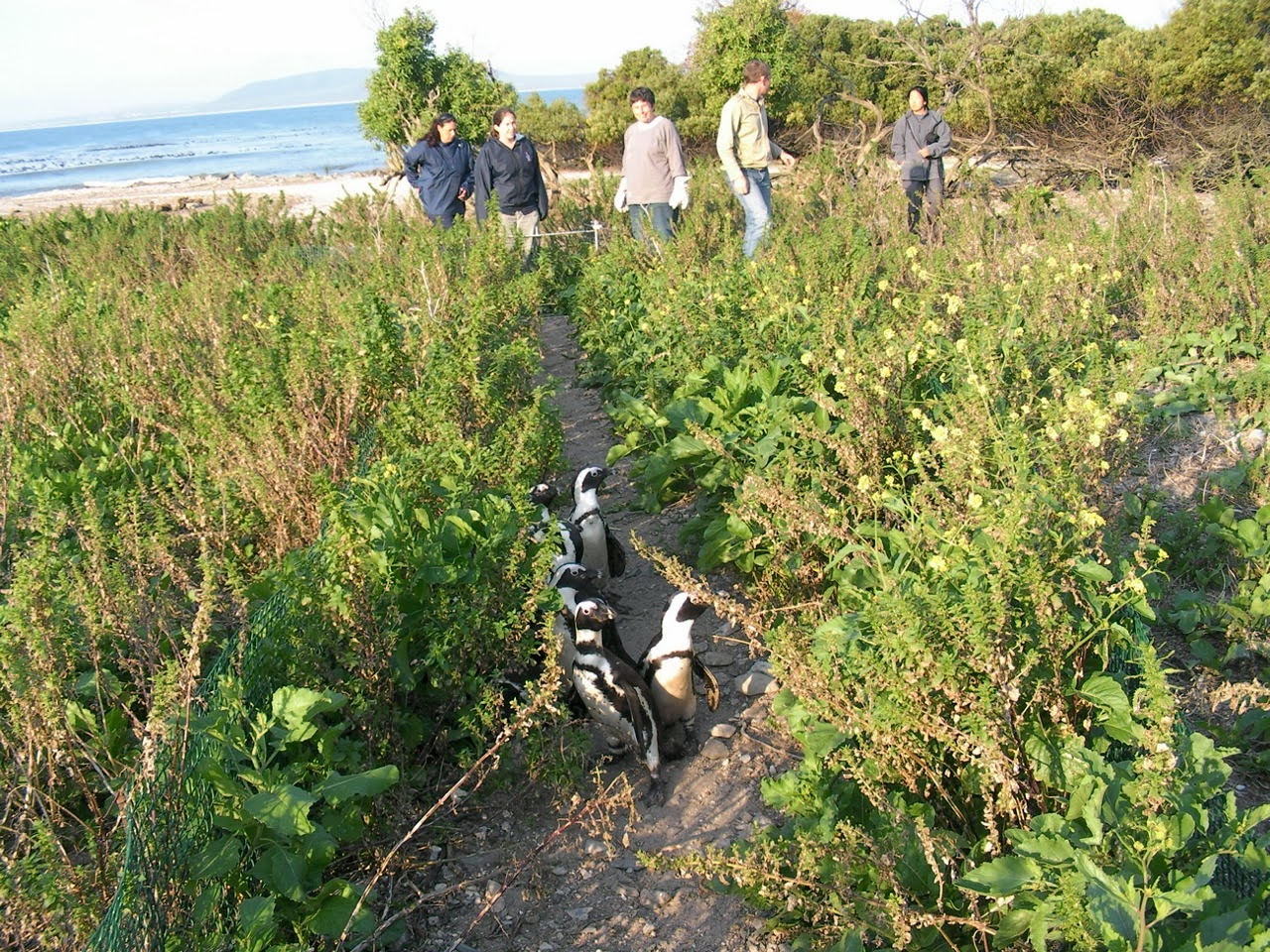
  • Penguins in South Africa: More than half of the 18 species of penguins around the world are considered either threatened or endangered. The African penguin population has decreased 95 percent since preindustrial times due to competition for fish with fishermen and other threats. Earthwatch Institute has worked with local researchers for the past decade to study and protect the penguins living on Robben Island, famous for the prison that once held Nelson Mandela and many others during apartheid.  Volunteers will help collect data on the penguins including growth rates of chicks and survival rates, key information that is needed to develop long-term protection plans.
  • Dolphins in Belize: The Mesoamerican Barrier Reef is the world’s second longest reef and is home to hundreds of marine species, including several species of dolphins. The Oceanic Society runs a marine station based on Turneffe Atoll that acts as a central location for researchers to study bottlenose dolphins, manatees, and others.


Tuesday, July 16, 2013

5 Things to Consider Before Choosing a Wildlife Conservation Vacation

Ecotourism, green travel, sustainable tourism, call it what you will. Whatever its title, reducing the negative impacts of travel is one of the fastest growing parts of the tourism market and one that has the potential to significantly reduce carbon emissions, support low-income communities, and benefit efforts to protect endangered animals.

Cheetah in South Africa (credit Wildland Adventures)
Unfortunately, so far, the impact of travel (whether good or bad) on wildlife has been an afterthought for most travelers. Tourism and the infrastructure it requires can destroy wildlife habitat, worsen climate change, result in litter and other pollution, and increase stress on wild animals. When done carefully, however, what we call “wildlife conservation travel” can also help wildlife in several ways, including generating funds for local conservation groups and providing volunteer help. 


Perhaps the biggest way that conservation travel can help endangered animals is by creating economic benefits for local residents who otherwise would earn a living by fishing, hunting, or other activities that harm animals. 

As you plan your next vacation, here are some things to think about before you decide where to go and what activities to do.

1. Is the destination a wildlife hotspot?

According to Conservation International, about half of the world’s species live in “biodiversity hotspots” which take up less than 5 percent of the world’s land. If you go to one of these spots, read up on which animals live there and look for opportunities to visit research and conservation programs. Some of these programs may offer short-term volunteer programs where you will get an experience that few travelers get to participate with. Many of these programs work through tour operators that offer these experiences while taking care of your transport, food, and accommodations.

2. Does Your Tour Operator Support Conservation and Local Communities?

(credit Wildland Adventures)
If you decide to travel through a tour operator, do your research to make sure they actively support environmental and social projects in the places they go. Some operators will offer discounts for travelers who donate to funds that they set up to support these community groups, a great example is the Travelers Conservation Trust set up by Wildland Adventures. Most of the operators who truly support these programs will be transparent about who they donate to. 

If you don’t see that information, make sure you ask the operator what they do to support wildlife conservation. After all, if their business is based on travelers going to Africa to see lions or India to see tigers, shouldn’t they want to make sure those animals will always be around? If they can’t answer that question, let them know that you’ll be looking elsewhere; there’s no better way to motivate a company to improve their practices.

3. Does Your Operator Go Beyond Donations?

Bear watching in British Columbia
(credit Kevin J. Smith/
Maple Leaf Adventures)
Giving money is one of the easier ways to support wildlife. Other questions to ask operators are if they support environmental protection and residents in ways other than donations. Do they offer volunteer programs? Employ people from nearby communities and use locally-owned hotels and restaurants? Do they advocate for wildlife protection or participate in efforts to improve tourism practices? One of the best examples of going beyond donations is Canada’s Maple Leaf Adventures. In addition to donations, their founder Kevin Smith has been a leader in setting tourism standards for the Haida Gwaii Islands and promoting bear watching over bear hunting in British Columbia.

4. Do Your Vacation Plans Include Activities That Could Harm Wildlife?

Now that you know the animals that live where you are going and how much your operator supports them, the next thing to think about is if the activities you do and places you stay might impact local wildlife. Are you staying in a high-rise chain hotel on a turtle nesting beach? If so, you might want to look for a locally-owned cabin away from where the turtles come. If you plan to use jet-ski’s or boats, make sure to stay away from habitat for manatees and other animals, drive slowly, and obey all regulations. Check out our Turtle Watching Guide for ways to prevent impacts to turtles on nesting beaches and at sea. The Coral Reef Alliance also has several guides for travelers.

5. Stay Off the Beaten Path


Leatherback turtle in Costa Rica (credit Neil Osborne)
Many of the most popular places to see wildlife become overrun with tourists, encouraging uncontrolled development which impacts wildlife habitat. However, by doing a little research, you can usually find other places to see that animal that don’t get nearly so much traffic. There are dozens of turtle nesting beaches in Costa Rica, yet the vast majority go to Tortuguero National Park. Instead of following the crowds to see lions in South Africa, think about places like a primate research project in Kenya or Namibia’s Communal Conservancies for your next African safari.  

Friday, June 14, 2013

Bringing Light to the Darkness: The Conservation Legacy of Jairo Mora Sandoval

On Friday, May 31st, while returning from a long night walking a turtle nesting beach near the city of Limón, young Costa Rican conservationist Jairo Mora Sandoval was abducted by unknown assailants, beaten and murdered. The beach where Mora Sandoval worked is a hot spot for nesting by the critically endangered leatherback, but also well-known for poaching and as a transfer point for drugs entering Costa Rica. This beach has now become a flash point for the direction that Costa Rica will go as a country.

The brave young man had recently spoken out to the media and on social media about the lack of government support for the conservationists on this beach. With a Ministry of Environment tolerant of the illegal trade in sea turtle eggs, and without effective enforcement over a flourishing black market, efforts by local Police and Coast Guard have routinely fallen short of what is needed to safeguard people working tirelessly to protect the nation’s natural treasures. It was in this context that a small group of conservationists were left on their own against the poachers and drug runners. They had received threats, but never thought their work to protect endangered turtles would result in a tragedy like this.

I spent two years of my life walking Costa Rica’s turtle beaches. I know what it’s like to be in the dark, with little to defend yourself. I worked for the same organization that Jairo worked for, learning from Didiher Chacón, Country Coordinator and Director of Latin American Programs for the Wider Caribbean Sea Turtle Conservation Network (WIDECAST) and one of the country’s leading conservationists. I never felt threatened on those beaches, but that experience was challenging enough, dealing with rain, insects, and more to make sure the nests were protected.

Costa Rica is known around the world as the place where ecotourism was born. The country has beautiful beaches, lush tropical forests, and the most species of wildlife per kilometer in the world according to some. Sea turtles are a main attraction, nesting on dozens of beaches on both coasts and attracting thousands of people each year to see them nesting. Hundreds of people come to volunteer annually on these beaches without incident, spending their time, money, and sweat with the goal of contributing to the conservation of these incredible animals.

The volunteers and travelers that come to these beaches are critical, now more than ever, to the success of efforts to protect sea turtles in Costa Rica and around the world. The heavy lifting of turtle conservation work in Costa Rica is not done by the government. Instead, dozens of non-profit organizations toil long hours, for very little income, to make sure the eggs, meat, and shells are not collected for sale on the black market. Rarely do the police, Coast Guard, or rangers from the Ministry of the Environment walk the beaches or enforce the laws. Poachers are caught red-handed and go without prosecution. Fortunately, most of the country’s nesting beaches do not have the danger of Moin Beach and conservationists and volunteers can safely walk the beach without worry of danger.

When the government of Costa Rica spends millions of dollars to market itself as a wildlife paradise but next to nothing to protect that wildlife, will the volunteers and tourists still come? President Chinchilla must show the world that they will not stand silent when the people most dedicated to protecting the country’s natural resources are cut down for speaking out. Jairo’s family – and his many friends and colleagues – will never be the same, but some good can come from this. The government can name Moin Beach a National Park in his honor, securing this beach for both the turtles and the conservationists and taking away an entry point for drugs.

Each of us who shares Jairo’s passion for biodiversity conservation work can help to ensure that the world never forgets his contribution to Costa Rica’s sea turtles.  

Friday, June 7, 2013

Are Costa Rica’s Beaches Safe?

The awful news about the murder of Costa Rican sea turtle conservationist Jairo Mora Sandoval has shocked the world. Jairo was a brave young conservationist working hard to protect an important leatherback turtle nesting beach called Moin Beach, near the port city of Limon on the Caribbean coast. The beach was well-known both as a place for poachers to collect turtle eggs and a key location for drugs to enter Costa Rica. Along with Jairo, four volunteers from the US and Spain were locked into an abandoned house and robbed (they later escaped unharmed).

Many people come to Costa Rica’s beaches each year to see sea turtles nesting or to volunteer with conservation programs. These visitors and volunteers are critical to the success of local organizations, providing both manpower and funding to continue their work. We connect more than 100 people each year to turtle projects with no incidents. With this recent news, many people now want to know whether its safe to go to Costa Rica.

Most of the country’s beaches do not face the danger that exists at Moin Beach. The majority of turtle nesting beaches in the country are remote with few people living nearby and are not used for transporting drugs. While poaching exists across the country due to a lack of enforcement by government authorities, in most places the people that collect the eggs do so away from researchers and conservationists that patrol the beaches. Its rare for a poacher to confront a conservationist and most turtle projects have safety measures in place to make sure that the beaches are safe and only Costa Ricans interact with local residents on the beach at night.


Costa Rica’s sea turtles need the help of volunteers and tourists now more than ever. Its always a good idea to check with the organizations that run the conservation programs to see what safety measures they have in place and what the current situation is as well as with the State Department. We are confident that the beaches where we send people are safe and would not put anyone in danger by organizing a trip or recommending a place that might not be safe.

Monday, June 3, 2013

5 Things You Can Do To Protect The Ocean

World Ocean Day is coming up on June 8th and what better way to celebrate than by helping to protect the ocean and the creatures that call it home? Most of the news we hear these days about the ocean is bad; giant islands of trash, sharks being killed for their fins, and more. But there is still hope to save the oceans and everyone can help no matter how far you live from a coast.

1. Use Less Plastic
Many people have heard of the Great Pacific Garbage Patch out north of Hawaii; not many people know that all five of the world’s oceans have currents (called “gyres”) that collect plastic waste. This waste endangers sea turtles, birds, seals, and other wildlife.

How to help: First, avoid plastic wherever possible. You can support local bans on plastic bags and take the Plastic Pollution Coalition’s Pledge to refuse disposable plastic. You can also volunteer in the International Coastal Cleanup and help keep trash out of the oceans.

2. Eat Less Fish or More Sustainable Fish
Many of the world’s major fish stocks are overfished and collapsing. This is more than a food issue; these fish make the marine food web survive and many coastal communities depend on the industry. The good news is that there are alternatives for those who don’t want to completely give up seafood.

How to help: First, avoid the most damaging seafood such as shrimp. In some places, fishermen catch up to 10 lbs. of other fish and animals for every pound of shrimp. Also, print out a Seafood Watch Guide or download their smart phone app that tells you which fish are being caught sustainably and which ones can have high levels of toxins.

3. Use Your Voice (or Your Email)
There are many opportunities to speak up for ocean conservation. For example, you can participate in the Sea Turtle Restoration Project’s campaign to enforce the use of turtle excluder devices on shrimp boats in Louisiana by emailing your Senator.

4. Volunteer With A Sea Turtle Conservation Project
Ever wanted to see what the life of a marine biologist is like? Our SEE Turtles project helps connect volunteers with sea turtle conservation programs in Latin America at no charge. Patrol a turtle nesting beach, helping to measure and tag sea turtles and move their eggs to a protected hatchery. Volunteers pay from $15-50/day for food and lodging, which is a critical source of income for many small projects.

5. Take An Ocean Wildlife Conservation Tour
SEEtheWILD is the world’s first non-profit wildlife conservation travel project and our website promotes tours where you can get up close to ocean wildlife including sea turtles, sharks, and whales. Every trip benefits conservation programs through donations, education, and volunteer opportunities.

Bonus Action: Share A Blue Marble

The Blue Marbles Project is a simple experiment in showing gratitude for the ocean. Millions of these marbles are passing around the planet, from hand to hand. The premise is simple, give a marble to someone doing good things for the ocean. Pick up some marbles here and share the stories of the people you give them to on Facebook.